
Insights and News
She Was Told She Couldn’t Reverse Osteoporosis. She Proved Them Wrong.
Blog
June 02, 2026
Anna Maxted is a respected journalist and author who writes for The Times. Last week, she was on the front page herself, with a story that every woman over 45 in the UK should read.
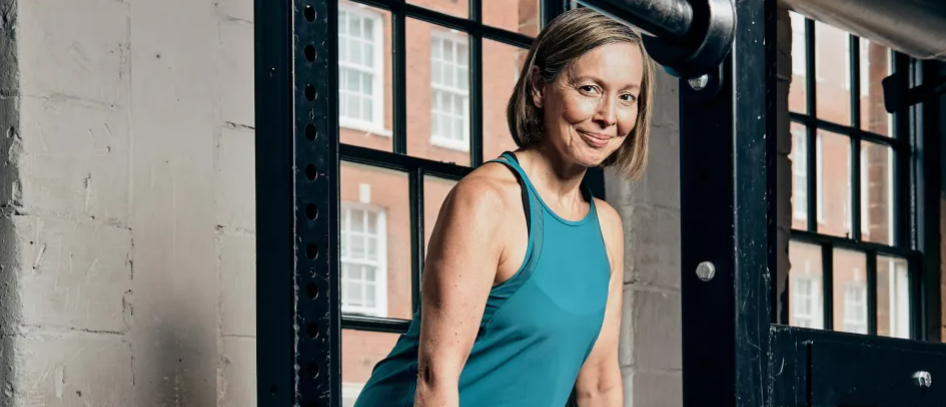
At 55, she was diagnosed with osteoporosis. She felt she was fit and fine, but her trainer suggested that, because of her age and her exercise routine, she have it checked.
Her T-score at the left hip was -2.7. Severely osteoporotic!
An NHS specialist told her that trying to reverse it through targeted exercise was pointless, like “turning on a tap to fill a sink with an open plughole”. His advice was to accept it, slow it down with medication, and deal it.
She ignored him.
18 months later, her sports therapist delivered the good news. A 7% increase in bone density at the hip. and1.34% at the spine. Fracture risk reduced by an estimated 35%. Her left hip is no longer classified as osteoporotic. No meds.
Osteoporosis affects around 3.5 million people in the UK. It causes over 500,000 broken bones every year. Half of all women over 50 will suffer a fracture because of it. Hip fractures alone carry a one-year mortality rate of 33%, and cost the NHS £2 billion annually.
This is not a niche issue. It is a public health crisis hiding in plain sight, partly because the condition is silent, and partly because the prevailing message for too long has been, there is not much you can do, besides take the medication.
What she actually did
She committed to a serious, structured protocol. Three sessions a week of progressive strength training, deadlifts, squats, jump work, because bones respond to mechanical stress in a way that swimming and steady-state cardio simply cannot replicate. She overhauled her nutrition. She cut back swimming to twice a week because, as she put it, she had been “avoiding gravity like an astronaut”.
The centrepiece of her programme was a static osteogenic loading machines, the technology that OsteoStrong is built on. The machine allows users to safely generate forces far beyond what conventional exercise can produce. Anna worked up to pressing 613kg through her legs. Safely. That level of mechanical load, many multiples of bodyweight, is what triggers the bone-building response that traditional resistance training simply cannot reach.
Her progress was tracked using EchoLight REMS scanning, again the same technology we use at OsteoStrong in Tunbridge Wells. Unlike a standard DEXA scan, REMS measures not just bone mineral density but bone microarchitecture, the actual quality and fracture resistance of the bone itself.
Vonda Wright MD, MS orthopaedic surgeon, longevity specialist, reviewed Anna’s results and said: “This is what women need to hear. My approach would be exactly what you’ve done.”
What this tells us about bone biology. Anna’s story is not a miracle. It is the result of understanding how bone biology works and applying that knowledge consistently over 18 months.
Bone is living tissue. It responds to load. It responds to impact. It responds to the signals you send it, or it disappears quietly in the absence of those signals. The challenge has always been delivering enough mechanical force safely, particularly for people already diagnosed with low density.
That is precisely the problem osteogenic loading technology was designed to solve. Once a week. Around 15 minutes. No sweat. No strain.
Matt Roberts , The personal trainer who first suspected she was at risk and referred her for scanning, is doing important work in this space, worth knowing about.
At OsteoStrong Tunbridge Wells, we offer both osteogenic loading technology and Bone Screening using EchoLight REMS scanning, same as Anna’s protocol.
If you have had a scan result that worried you, or you have simply never had one and suspect you probably should, come and talk to us. You do not need to wait for a fracture to act. You do not need to accept a slow, steady decline as inevitable..
It is time to turn the tap back on and make sure the plug is in place.